
Delhi Chief Minister and AAP National Convener Arvind Kejriwal unveiled the party's manifesto for the youth. The party, which is aiming to capture power in the state, will come out with separate manifestos for different sections of society.

'We say we are proud to be Indian. Can we be proud of such an India where its people are hungry and on the streets?'

'In Kairana, the grand coalition was able to transfer its votes to a Muslim candidate in supposedly an era of anti-Muslim ambience.' 'Given this perspective, the Kairana result seems more significant than that of Gorakhpur and Phulpur a few months ago,' says Mohammad Sajjad.

'There is enough proof of science-driven research in the India of early centuries,' argues Kumar Abhishek.

'The spread of barbarity in Muzaffarnagar's villages makes administrative complicity so very evident that your government is rightly alleged to be imitating what the Modi-led administration did in Gujarat in 2002,' Mohammad Sajjad tells UP Minister Azam Khan.

The NITI Aayog will now assimilate the views of states and then present a report to the PM.

'Why would the Communists do this? I have three possible answers: One, they are specifically opposed to the Global Education Meet that the ambassador organised. Two, they are beginning to realise their days are numbered in Kerala. Three, the standard modus operandi of leftists is anarchism because they are not constrained by any codes of ethics. Roughly, the bad, the good, and the ugly,' says Rajeev Srinivasan.

'Offensive operations to capture objectives across the LoC to eliminate terrorist launch pads and deny the use of the most dangerous routes of infiltration, are likely to be limited to brigade-level attacks.' 'These limited operations are unlikely to escalate to war across the international boundary,' says Brigadier Gurmeet Kanwal (retd).
'Only on two occasions has the RSS thrown itself completely on the side of the BJP.' 'In 1977 in the wake of the Emergency. And in 2014 with Modi.' 'Now, I've been told that this is not going to happen in 2019.'

Nitish Kumar has lost his credibility. He is now only a weak ally of the BJP. And he may no longer have a shot at a national role.
'But in 2024, the people of India will throw him out of power as the contradictions in him will be apparent.'

Colonel Anil Athale (retd) recalls how the Battle of Panipat, 258 years ago, changed the history of India for the next century and half.

'There is core BJP support on the Hindutva line. It will continue.' 'Along with that, the BJP is ready to play the OBCs trifurcation card to its benefit.' 'If you see the post-Kairana result, the BJP spokespersons and IT cell have already begun talking about Hindu unity against Muslim unity, Ram vs Allah.'

''I am not going to force anyone to watch movies. If they want to, they can come and watch.' 'I want to give them the choice that everyone has in the rest of the country.'

A key hindrance to a faster turnaround of these banks is the slow progress in the resolution of legacy bad loans and the need to build up provisions against those assets.
The record voter turnout in Rajasthan has forced politicians and psephologists to junk their pre-poll calculations. Now, all eyes are on the December 8 counting, says P B Chandra
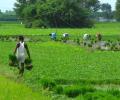
There is a drastic difference between genders in the right to inherit land. Over a decade after the Hindu Succession Act was amended, only one in ten women inherit agricultural land, points out Akansha Dubey.
VG Siddhartha's story 'will be a good case study and not a deterrent to those who want to be entrepreneurs. I don't think it will scare young entrepreneurs. I think these cases will make them sensible. They will understand that they have to be very careful about certain things, otherwise, they will have to pay a heavy price.'
As India's international role expands, so must our capabilities, says Brigadier Gurmeet Kanwal (retd).
Dalit votes could play a decisive role in 28-30 constituencies in the 230-member assembly.
'It does not look like unemployment is a priority for the government.' 'If there was one external factor which could have made an impact on low investment and low jobs, it was the Budget and it has not made any difference.' '2020 is going to be a difficult and challenging year.'

Farm loan waivers should not be regarded as expenditure but as incentive and investment, argues B S Raghavan, the distinguished civil servant.

This is the first time Pakistan and Kashmir have been brought into the narrative.

'Having dealt with security and insurgency for 15 years, I am fully convinced that the steps taken by the government in regard to J&K and the measures in force there are essential,' says B S Raghavan, the distinguished civil servant.
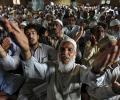
'The Ulema have come out as villains against Indian secularism, impeding the secular united resistance against violent Hindutva that is backed by ministers in the government,' says Mohammad Sajjad.

They will enable the people to access and enjoy the same rights, same privileges and same facilities as their fellow citizens in the rest of the country, he said.
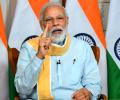
'Citizens have given money to PM-CARES, so they have the right to know what has happened to their money.'
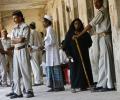
Muslims need to get out of their Isolation Syndrome, argues Mohammad Sajjad.

Prime Minister Narendra Modi on Thursday announced a Rs 745-crore package for renovation of houses and six major hospitals damaged by the recent unprecedented floods in Jammu and Kashmir.

In the concluding part of the series, Y V Reddy, argues that the proposal strikes at the functioning of federalism and the basic structure of the Constitution, which has served us well so far.

How soon can India reach a point when there is no hidden underemployment and all who want work can find it at a fair wage and decent work conditions, asks Nitin Desai.
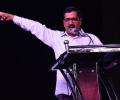
The street-fighter is back and the introspecting, sparingly speaking avatar of Kejriwal has gone on an extended recess. In this grime of heightened Delhi politics, all the good work done by the Delhi government may go down the drain, warns Sudhir Bisht.

One of the leading political analysts in Tamil Nadu, Gnani Shankaran speaks to Shobha Warrier/Rediff.com from Trichy on the Jayalalithaa verdict.
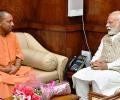
'The top-most functionaries and destiny-makers of the nation have thrown away the pretensions of statesmanship.' 'They seem to have made a categorical announcement that the next general election will be fought on the solo plank of Hindutva, rather than on good governance, economic development, and employment to youth', says Mohammad Sajjad.
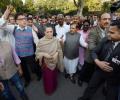
Why are the 'secular' parties silent about the lynchings on our streets? Are they so busy forging political alliances that they ignore the numerous distortions of Constitutional values?

For an institution looking to revive past glory, the Nalanda University's initial days have been far from glorious.

'Nitish is now a helpless junior ally of Hindutva.' 'He just cannot think of reining in the hoodlums raging, marauding and killing in the mohallas,' argues Mohammad Sajjad.

'The BJP capitalised on the Left Front's failure and inaction and the Congress' deliberate retreat in Tripura.'
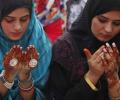
Over two dozen Muslims have been elected to the Lok Sabha. This shows that all is not lost for India's Muslims, suggests Mohammad Sajjad.

In a brief statement, Jung's office said he has submitted his resignation to the government of India and that he would be returning back to academics, 'his first love'.
